How to Aquascape a Bedroom Nano Tank: Silent and Calming

A bedroom aquascape has a different brief from a living room showpiece or office display. It needs to be quiet enough that you fall asleep alongside it, visually calming rather than stimulating, and practical enough to maintain without disrupting the room’s purpose. The bedroom nano tank aquascape is one of the most personally rewarding aquarium projects — the tank you return to at the end of a long day, watch for ten minutes from bed, and wake up to in the morning. Gensou Aquascaping at 5 Everton Park, Singapore has helped many Singapore hobbyists design exactly this: a quiet, beautiful, low-maintenance nano that lives comfortably in a bedroom.
Tank Size and Placement
For a bedroom, 20–45 litres is the practical sweet spot. A 30-litre cube (30 × 30 × 35 cm) or a standard 45P (45 × 27 × 30 cm) sits comfortably on a bedside table or low dresser without dominating the room. Weight is worth calculating before positioning — 30 litres of water plus substrate and glass weighs approximately 35–40 kg. A solid wooden bedside unit or a dedicated steel-frame tank stand handles this without concern; flat-pack furniture with particle board bases may not.
Position the tank away from air-conditioning vents, which cause temperature fluctuations and evaporation. A bedside placement to the left or right of the bed gives you a natural line of sight when lying down — the ideal viewing angle for a planted nano tank that has been designed with a sloping substrate and mid-water planting.
Silence Is the Primary Equipment Criterion
Filter noise kills the bedroom aquascape concept. Canister filters are the quietest option for tanks over 30 litres — sealed units that operate below audible thresholds when properly primed. Brands like Oase BioMaster or Eheim Classic series canisters are consistently quiet; cheap canisters vibrate against cabinets and hum. Place the canister inside the tank stand or on a rubber mat on the floor.
For tanks under 20 litres, a quality internal filter with a foam head or a low-flow HOB filter positioned so the return stream breaks the surface gently rather than crashing down is acceptable. Avoid air pump-driven filters in bedrooms — the constant bubbling, however gentle, is a sleep disruptor for lighter sleepers.
Lighting With a Timer and Dimming
A tank in your bedroom needs a light that switches off fully at a sensible hour. Use a smart plug or a basic digital timer to run the photoperiod during evening hours — a 6–7 hour window from around 14:00 to 21:00 suits most Singapore households where the bedroom is occupied later in the evening. Lights-out by 21:00–22:00 means no glow interrupting sleep.
If your LED supports dimming, a gradual ramp-down over 30 minutes before lights-off is pleasant — it replicates dusk and is better for fish and plant acclimation than an abrupt switch. Many affordable programmable LEDs now include sunrise/sunset functions; the Chihiros and Twinstar ranges available locally are worth considering for this feature.
Plant Selection: Calm, Green, and Low-Maintenance
Bedroom tanks reward slow-growth plants that require infrequent trimming. Anubias nana petite attached to driftwood, Bucephalandra species on small stones, and Microsorum pteropus ‘Narrow’ as background coverage are all appropriate. These plants grow slowly enough that a bi-weekly trim is not needed — a monthly tidy is sufficient, keeping maintenance unobtrusive.
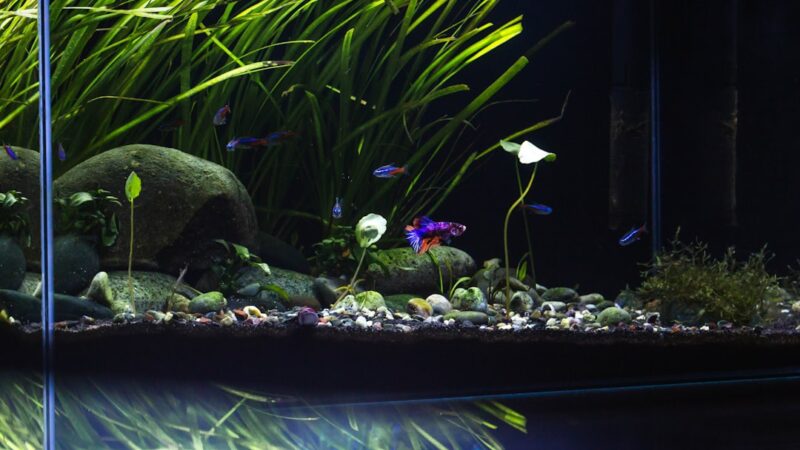
A single carpeting species — Helanthium tenellum or Marsilea hirsuta — across the substrate adds foreground depth. Mosses on driftwood provide texture. The overall palette should be calm and green rather than high-contrast reds and pinks that demand attention. This is a tank to relax into, not one that should feel busy or stimulating.
Fauna: Quiet and Stress-Free
Neon tetras and cardinal tetras add gentle movement to a bedroom tank without being energetically chaotic. A group of 8–10 cardinals in a 30-litre nano creates subtle, rhythmic movement that is meditative to watch. Neocaridina shrimp — cherry reds or yellow goldenbacks — graze constantly on every surface, providing the kind of micro-scale activity that rewards close observation on quiet evenings.
Avoid active, fast-moving fish like danios or barbs in a bedroom context — their unpredictable darting is energising rather than calming, which is the opposite of the intended effect. Peaceful, deliberate fish that explore slowly fit the bedroom aesthetic far better.
Maintenance Without Disruption
Weekly water changes of 20–25% are essential — less frequent changes allow nitrate to accumulate, which drives algae. Do water changes during daylight hours so the tank is settled and the lights are out before you use the bedroom in the evening. Gravity-fed siphon systems connected to a bucket under the tank make water changes a 10-minute task. Keeping a spare bottle of dechlorinated, temperature-matched water ready avoids waiting for tap water to come to temperature during the change.
The Intangible Value
Research on the therapeutic effects of aquariums — reduced heart rate, lower anxiety, improved sleep quality — consistently supports what any fish keeper who has owned a bedroom tank already knows: it works. A well-designed, quiet, visually calm bedroom nano aquascape from Gensou Aquascaping is more than a decoration; it is a small, functional piece of nature that makes the room it lives in measurably better.
Related Reading
- How to Aquascape for Celestial Pearl Danios: Galaxy Rasbora Nano
- How to Aquascape for Clown Killifish: Surface Nano Design
- How to Aquascape for Exclamation Point Rasboras: Dense Nano Jungle
- How to Aquascape for Forktail Rainbowfish: Pseudomugil Nano Display
- How to Aquascape for Licorice Gouramis: Ultra Soft Blackwater Nano