Amazon Blackwater Breeding Biotope: Tannin and Leaf Litter
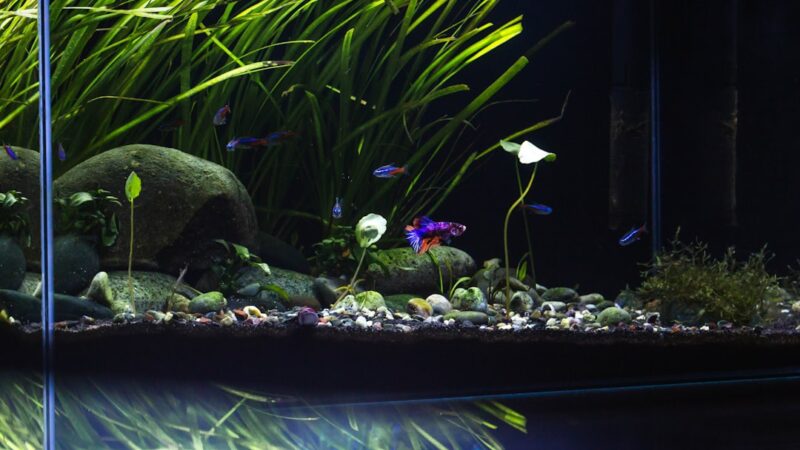
Black Rio Negro tributaries run the colour of strong tea, carry almost no mineral content, and host some of the most demanding yet rewarding breeding species in the hobby. This amazon blackwater breeding biotope guide from Gensou Aquascaping at 5 Everton Park is assembled from cardinal tetra, rummy-nose and Apistogramma agassizii spawn logs across client tanks in Singapore, where PUB tap provides a surprisingly strong starting point for soft-water builds. Plan on a 90-litre tank as the minimum for a useful breeding project.
What Blackwater Actually Is
Blackwater is soft, acidic water stained by tannins and humic acids leaching from flooded rainforest debris. Parameters target pH 4.5 to 6.0, KH under 1 dKH, GH 1 to 3, and conductivity under 80 µS/cm. The tannins do more than colour water; they suppress pathogens, trigger spawning hormones in many species, and buffer the water against bacterial bloom during egg incubation.
PUB Water as a Starting Base
PUB tap at roughly GH 3, KH 1 to 2, conductivity 90 µS/cm is close to a usable starting point but carries chloramine and sits slightly too alkaline. Dechlorinate with Seachem Prime, then acidify through botanicals rather than chemicals; chemical acidifiers without carbonate buffering cause pH crashes that kill fry fast. RO water mixed at 50:50 with tap drops conductivity to 45 µS/cm and gives more margin for tannin-driven acidity.
Substrate and Hardscape Choices
Use fine, inert sand or a thin layer of ADA Amazonia over quartz sand. Avoid active substrates that leach ammonia into an already low-pH environment; the cycle is slower and riskier in blackwater. Hardscape is Malaysian driftwood or Manzanita wood arranged as fallen branches, half-buried in substrate at angles that suggest a forest floor during flood season. Open sand patches in the foreground matter for pair display.
Botanical Layering and Tannin Sources
Carpet 50 to 70 percent of the substrate with Indian almond leaves, alder cones, oak leaves, and the occasional seed pod. Layer fresh leaves over decomposed ones rather than removing old leaves entirely; the mulch layer is part of the habitat. Supplement with a mesh bag of peat moss in the filter for sustained humic acid release. Our blackwater aquarium setup guide covers botanical rotation schedules.
Plants That Survive Low Light and Low pH
Most popular planted species struggle below pH 5.5, but a few thrive: Helanthium tenellum (formerly Echinodorus tenellum), Cryptocoryne cordata, and Nymphaea lotus hold up well. Floating plants — Amazon frogbit, salvinia, red root floater — shade the water column, diffuse light, and provide critical cover for fry. Target 30 to 50 PAR at substrate through floaters; light drives algae more than plant growth at low pH.
Filtration Without Disturbing Tannins
Sponge filters or matten filters are ideal. Canister filters work but consume carbon if you run it — never add activated carbon to a blackwater breeding tank, as it strips the tannins you just spent weeks building. Surface flow should be gentle; Amazonian flooded forest waters are near-still, and strong current disrupts spawning behaviour. Our apistogramma breeding tank guide expands on flow tuning for dwarf cichlids.
Temperature and Singapore Ambient
Amazon flood-season temperatures sit at 26 to 29 degrees, which aligns neatly with SG HDB ambient. No heater needed for nine months of the year. During December’s marginally cooler spells, ambient may drop to 25 degrees at night, which actually triggers spawning in many species. Embrace the natural drop rather than fighting it with a heater.
Species That Breed Well in This Setup
Cardinal tetras, rummy-nose tetras, black neon tetras, and Apistogramma agassizii or A. cacatuoides all breed reliably in a properly set blackwater tank. For tetras, condition adults on live or frozen food for two weeks, then add a spawning mop or fine-leaved plant cluster like Java moss. Apistogramma spawn in caves under leaf litter; a coconut half-shell with a 2 cm entrance works as well as any pre-made cave.
Fry Rearing in Stained Water
Free-swimming tetra fry are tiny and need infusoria for the first week, transitioning to freshly hatched brine shrimp by day five. Apistogramma fry are larger at swim-up and accept brine shrimp immediately. Feed sparingly; blackwater tanks are biologically less tolerant of overfeeding than neutral setups. Water changes during fry rearing should be 5 percent twice weekly with pre-matched blackwater from a holding bucket.
Maintenance Rhythm and Leaf Rotation
Replace 20 to 30 percent of spent leaves monthly. Add fresh leaves over the old rather than stripping the tank; the constant background decay maintains stable tannin levels. Test KH weekly; if it drops below 0.5 dKH, add a pinch of crushed coral in a mesh bag to stabilise. Target pH 5.5 to 5.8 for the breeding tank’s mature state; chasing pH 4.5 is possible but fragile in a hobby setup.
Timeline From Setup to First Spawn
Budget six weeks for the tank to settle botanically, another two to four for breeders to condition, and a first spawn inside three months of setup. Cardinal tetras need the longest conditioning; Apistogramma pairs can spawn within ten days of introduction. The payoff is a tank that produces steady fry for years with surprisingly little intervention.
Related Reading