Rift Malawi Breeding Biotope Setup Guide: Sand and Rock

Lake Malawi sits 474 metres above the East African rift floor, holds water at pH 7.8 to 8.6 with hardness far beyond anything PUB delivers, and houses cichlid species that evolved to breed in open sand trenches and rocky cave labyrinths. This guide to a rift malawi breeding biotope setup from Gensou Aquascaping at 5 Everton Park draws on years of mbuna and peacock spawns in SG HDB flats, where tap water is the opposite of what these fish need and remineralisation is the first task, not the last. Plan on 240 litres minimum for a useful breeding colony.
Why Malawi Is a Water Chemistry Project First
Unlike Amazon or West African builds, where PUB tap gets you close by default, Malawi requires genuine hardware and bagged minerals. Target GH 12 to 18, KH 10 to 14, pH 7.8 to 8.4 and conductivity 500 to 800 µS/cm. The fish spawn, display colour and resist disease when those numbers hold; drop KH below 8 and cichlid immune function wobbles within weeks. Aragonite substrate and a small bag of crushed coral in the filter are the two cheapest levers.
Substrate, Aragonite and Hardness Maintenance
Lay 6 cm of CaribSea Aragamax or a local equivalent across the base. The substrate slowly leaches calcium and carbonate, buffering the tank indefinitely. Sand grain size between 0.5 and 1.5 mm lets sand-sifters like Pseudotropheus elongatus work the substrate naturally. Our lava rock mbuna aquascape guide covers the structural layout in more detail.
Rockwork That Creates Territory
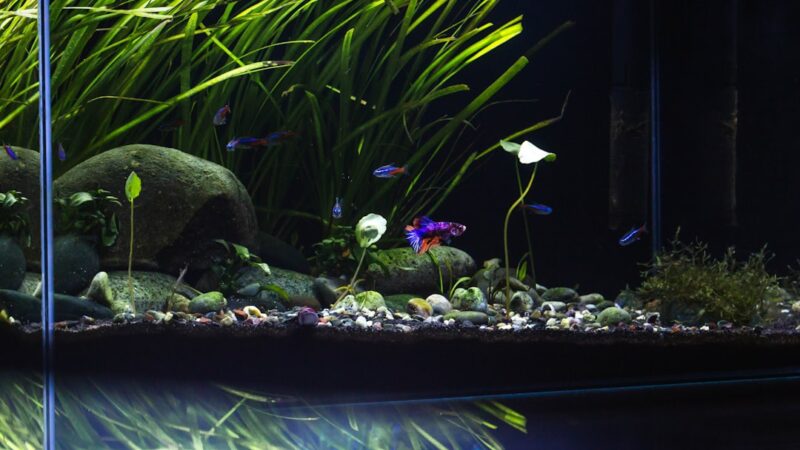
Build rockwork from Texas holey rock, lava rock, or Ohko stone in interlocking stacks rising to two-thirds of tank height. The goal is dozens of crevices, each sized to a single fish. Leave clear swimming lanes along the front glass and open sand patches between stacks for female colour display during spawning. Dry-fit everything before filling; a collapsed stack takes fins with it. Glue critical connection points with aquarium-safe cyanoacrylate.
Species Selection for Breeding
Stock one species per tank if you want pure fry. For mbuna, Labidochromis caeruleus (yellow lab) is the forgiving entry species; Pseudotropheus demasoni is the harder, more rewarding build. For peacocks, Aulonocara stuartgranti “Ngara Flametail” breeds reliably in SG conditions. Stock one male to three or four females; single-pair peacock setups almost never spawn because the female has no-where to dodge an over-enthusiastic male.
PUB Tap Remineralisation Workflow
Raw PUB arrives at KH 1, GH 3, too soft for Malawi. Remineralise with a blend of baking soda (for KH), Epsom salt (for magnesium) and calcium chloride (for calcium). A working ratio for a 240-litre tank starts at 15 grams baking soda, 8 grams Epsom salt and 10 grams calcium chloride per refill, adjusted against a Salifert or Tetra KH/GH kit. Our CaCl2 remineralise guide has the full formulae.
Filtration and Flow Requirements
Malawi cichlids produce heavy waste loads. Run two filters rated at five to six times tank volume per hour in total; a canister plus an internal or a large HOB is typical. Place outlets to create a circular current across the front of the tank. High oxygen levels matter; surface agitation is non-negotiable because the fish fight, display and spawn more actively in well-aerated water.
Temperature, Ambient Singapore, and Chiller Questions
Malawi wild temperatures sit at 24 to 27 degrees. Singapore ambient regularly pushes HDB rooms to 29 to 31 degrees during the day. Peacocks tolerate 28 to 29 degrees with no visible stress if oxygen stays high; above 30 degrees, colour fades and spawning slows. For serious breeders, a 1/8 HP chiller set to 26 degrees pays for itself in spawn reliability. Alternative: a clip fan plus AC in the room during peak midday.
Feeding for Breeding Condition
Mbuna are primarily herbivores; overfeeding animal protein causes Malawi bloat, which is effectively a death sentence. Stick to Spirulina-based pellets, blanched vegetables (peas, zucchini, spinach), and occasional Mysis shrimp. Peacocks tolerate more protein but still benefit from a vegetable-heavy diet. Feed twice daily, five days a week, with one fasting day. Our mbuna rock tank guide covers stocking density trade-offs.
Spawning Behaviour and Fry Collection
Malawi cichlids are mouthbrooders. The female collects fertilised eggs into her buccal cavity and holds them for 18 to 22 days without feeding. After about 14 days you can strip the female into a separate tumbler or leave her to release naturally. Stripping improves fry survival significantly and returns the female to full condition faster; use a soft net and a shallow holding container. Our hatching jar guide covers egg tumbler setups for freshwater cichlids.
Water Changes on a Hard-Water Tank
Change 25 percent weekly with pre-remineralised water matched to tank parameters. Pre-mix refill water in a 60-litre plastic bin a day ahead; remineralisation minerals take three to four hours to dissolve fully. Siphon detritus from open sand regularly; mbuna kick up debris that settles at the base of rockwork and rots silently.
Expected Timeline and Production
A well-conditioned yellow lab colony produces 15 to 25 fry per female per spawn, with spawns every six to eight weeks. A four-female colony can generate 60 to 100 fry per cycle once established. Budget three months from setup to first reliable spawn; the delay is usually social hierarchy setting rather than water chemistry.
Related Reading