
Gold Angelfish Care Guide: Yellow Body Variety
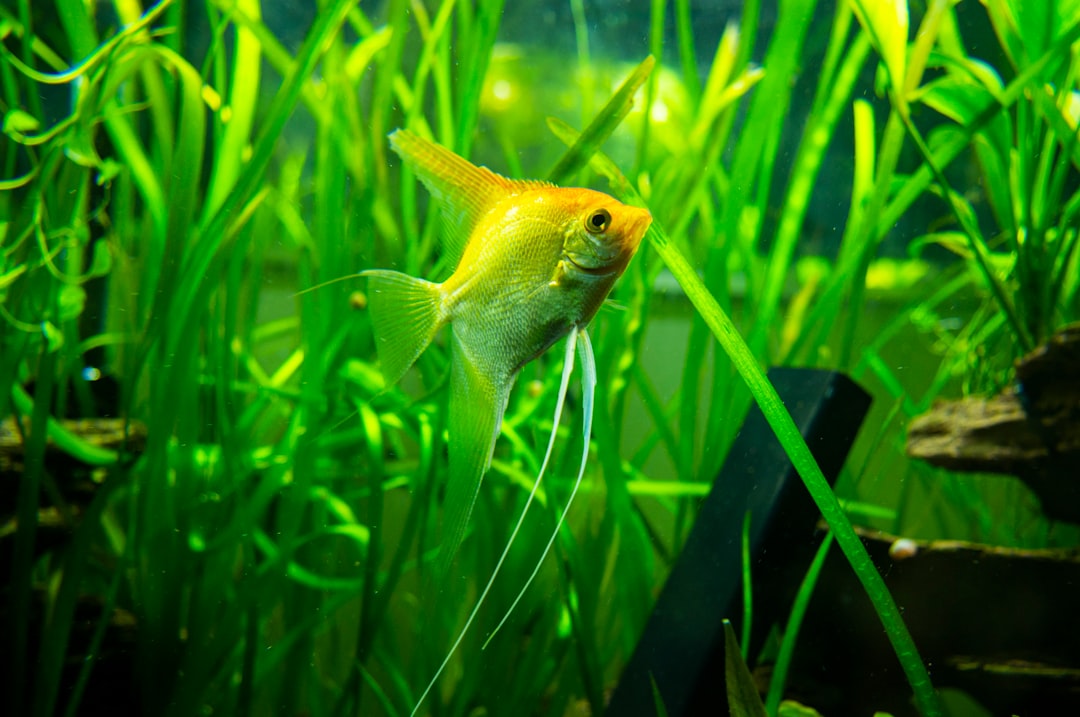
The gold angelfish is the clean-canvas version of every fancy angel strain — a warm yellow body, no patterning, and a soft orange head crown that deepens with good feeding. This gold angelfish care guide from Gensou Aquascaping in Everton Park, Singapore is written for hobbyists who want a uniform-colour angelfish that reliably looks show-quality in a planted tank. Genetically, gold angels are Pterophyllum scalare homozygous for the recessive gold (g/g) allele, with no marble overlay.
Quick Facts
- Scientific name: Pterophyllum scalare (gold colour form)
- Genetics: homozygous recessive g/g, no dark (D) allele
- Adult size: 13-15 cm body length, 18-22 cm fin-to-fin
- Minimum tank: 200 litres, 50 cm tall
- Water: pH 6.5-7.5, GH 3-10, 26-30 degC
- Diet: omnivore, colour-enhancing foods with astaxanthin improve crown saturation
- Lifespan: 8-10 years
What Makes a Gold Angel Gold
The gold gene is a recessive allele discovered in the early 1970s. Two copies (g/g) remove the silvery iridophore layer, revealing the underlying yellow pigment. Without dark (D) alleles, there is no black patterning. The result is a uniform buttery yellow body. Unlike koi angels, the base colour is pure — any black spot on a true gold is a disqualification in breeder circles.
Choosing Quality Stock
Juveniles often look pale. A good gold will show warm yellow on the flanks and a hint of orange at the forehead by 5 cm body length. Avoid specimens with greyish tinges (indicating unwanted Dark alleles) or misshapen fins. Singapore retailers carry farm-bred gold angels year-round at $10-20 SGD for juveniles and $35-50 SGD for adults.
Tank and Aquascape
A 200 litre tank suits a pair; a 300 litre tank houses a community of six. The yellow body looks striking against dark substrate and green plants — ADA Amazonia or similar black aquasoil with Amazon sword, Cryptocoryne wendtii, and Limnophila sessiliflora makes an effective backdrop. Avoid bright white substrate, which washes out the colour visually.
Water Chemistry
Gold angels are tolerant of standard Singapore tap water. pH 6.8-7.4, GH 3-8, KH 2-5, and 26-28 degC form the reliable range. Chloramine-treated tap should be neutralised with Seachem Prime or equivalent before every water change. Weekly 25 percent changes keep nitrate under 20 ppm and fins in good shape.
Diet for Colour and Growth
The crown colour responds strongly to carotenoid intake. Rotate Hikari Saki-Hikari colour enhancer, NLS Thera-A, and spirulina flake. Live or frozen brine shrimp enriched with selcon deepens the yellow. Two feeds a day, fasted one day per week, produces healthy fish with clean lines and strong colour.
Temperament and Tank Mates
Calm and social in groups, territorial during breeding. Pair with rummynose tetras, harlequin rasboras, Corydoras sterbai, bristlenose plecos, or peaceful dwarf cichlids such as Bolivian rams. Avoid any fish small enough to eat (neon tetras, ember tetras) or aggressive enough to fin-nip (tiger barbs).
Breeding Gold Angels
Gold x gold breeds true — 100 percent gold offspring. Gold x silver produces all silver fry carrying one hidden gold allele; back-crossing gives 50 percent gold. Pairs spawn on vertical surfaces every two weeks when well fed. Fry grow steadily on microworms and baby brine shrimp, reaching sellable size in 10-12 weeks.
Related Reading



