How to Aquascape for a Mystery Snail Display Tank

Mystery snails are not just tank cleaners — in the right aquascape, a group of Pomacea bridgesii in different colour morphs becomes a living decoration that draws more visitor comments than the fish. A gold snail moving deliberately across dark stone, a magenta one ascending green java fern, an ivory snail half-submerged in moss — these are visual moments that require a designed environment to frame them properly. Designing an aquascape for a mystery snail display tank means thinking about contrast, plant durability, calcium chemistry, and the practical reality that these animals will redecorate your tank constantly. Gensou Aquascaping at Everton Park, Singapore has built display tanks centred on mystery snails for clients who want something genuinely unusual as a conversation piece.
Choosing a Background Colour for Maximum Shell Contrast
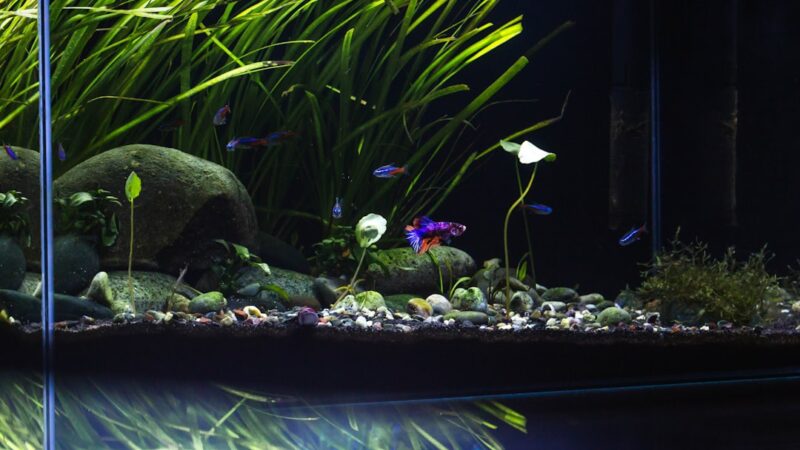
Shell colours — gold, magenta, blue, ivory, and striped variants — show best against dark backgrounds. A black or very dark blue aquarium backing film creates the strongest contrast, making even a pale ivory snail visible from across a room. Dark substrate — black sand or deep brown planted tank soil — serves the same purpose at the bottom of the tank. Avoid light or natural-coloured backgrounds where gold and ivory snails disappear against the substrate visually.
Arrange multiple colour morphs deliberately: cluster two or three together of contrasting colours, and leave open substrate paths where snails can travel and be clearly visible. Mystery snails do their own rearranging eventually, but starting with intentional placement gives the tank its initial visual structure.
Plant Selection: What Mystery Snails Will and Will Not Eat
This is the central challenge of a mystery snail display tank. Pomacea bridgesii is widely considered less destructive to plants than apple snails (Pomacea canaliculata), but they will still graze on soft, thin-leaved plants when hungry. Java fern (Microsorum pteropus), anubias species, and bolbitis are reliably snail-resistant — the leaves are too tough for snails to rasp effectively. These attach to hardscape rather than rooting in substrate, which also means the snails cannot uproot them during their constant wandering.
Avoid fine-leaved stem plants, delicate mosses, and any soft foreground carpets like Hemianthus or Monte Carlo — these will be consumed. Java moss in moderate amounts survives because snails graze rather than consume it entirely; hornwort is another tough, fast-growing option that recovers from grazing damage quickly. Keep plants well-fed with fertiliser so regrowth outpaces any grazing pressure.
Hardscape for a Snail-Friendly Aquascape
Smooth stone surfaces and driftwood serve both as aesthetic elements and as grazing surfaces for biofilm that mystery snails actively seek. Large, smooth river stones in dark grey or black contrast beautifully with colourful shells. Driftwood provides vertical interest and allows snails to climb — a mystery snail ascending a piece of twisted cholla wood is genuinely beautiful to watch.
Avoid very sharp-edged stones or rough-textured hardscape that could damage the snail’s soft tissue around the shell opening. Dragon stone, while visually striking, has angular edges that are not ideal for a tank where animals spend considerable time in contact with every surface.
Water Chemistry: Calcium Is Non-Negotiable
Healthy mystery snail shells require calcium — without adequate dietary calcium, shells pit, crack, and develop holes that expose the snail to infection and stress. Singapore’s tap water is soft (GH 2–4), which is below ideal for mystery snails. Supplement calcium by adding crushed coral to the filter media, placing cuttlebone (widely available in pet shops for $2–$5) in the tank, or dosing liquid calcium supplement weekly.
Target a GH of 8–12 for healthy shell development. Monitor with a GH test kit and increase the calcium source if shells show surface pitting or a chalky, eroded texture. Feed calcium-rich foods — blanched kale, spinach, and zucchini — as part of their diet to supplement dissolved calcium from the water.
Tank Size and Stocking
Mystery snails produce significant waste, and their bioload is higher than it appears from their slow movement. A 40-litre tank handles four to six adult snails comfortably with weekly water changes. Pair them with small, peaceful fish that will not nip at their antennae — small rasboras, peaceful tetras, or a group of ember tetras suit the tank size and leave the snails entirely unbothered. Avoid gouramis, puffers, or any cichlid species that will harass or consume snails.
Feeding and Maintenance
Supplement grazing with blanched vegetables two to three times per week — cucumber, zucchini, and leafy greens disappear within hours in a well-stocked mystery snail tank. Remove uneaten food after 24 hours to prevent water quality deterioration. Perform 25–30% water changes weekly, and check that the water line is not too close to the tank lid — mystery snails lay eggs above the waterline and require the gap between water surface and lid to deposit their distinctive pink-orange egg clusters. A 5–8 cm gap is standard practice.
Related Reading