How to Create Depth Illusion in Aquascaping: Foreground to Background Tricks
A planted aquarium is fundamentally a three-dimensional scene compressed into a shallow glass box. The front-to-back depth of most tanks is just 25-40 cm, yet skilled aquascapers routinely make these same tanks appear to extend indefinitely into the distance. The secret lies in understanding and combining multiple aquascaping depth illusion techniques that manipulate how your eyes interpret spatial relationships. At Gensou Aquascaping, 5 Everton Park, Singapore, we have refined these methods across 20-plus years of competition and client work, and this guide distils our practical approach into steps you can apply immediately.
Substrate Elevation and Sloping
The simplest and most effective depth technique is raising the substrate from front to back. A slope that rises 5-10 cm over the tank’s depth creates the impression of a landscape receding into the distance, similar to looking across a rolling hillside. Build the rear elevation using lava rock, pumice or commercial substrate supports beneath your planting soil to prevent the slope from flattening over time. ADA’s Power Sand or a layer of coarse gravel provides structural stability beneath fine aquasoil. Without internal support, even the most carefully sculpted slope will gradually collapse under the influence of gravity and water movement.
Layered Planting Zones
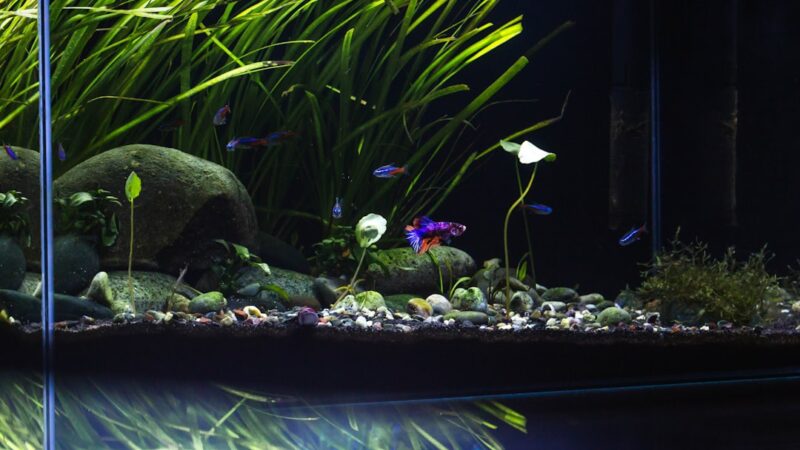
Dividing your tank into distinct foreground, midground and background planting zones is foundational to depth perception. Each zone should contain plants of proportionally different heights and leaf sizes. Carpet species like Hemianthus callitrichoides ‘Cuba’ or Eleocharis acicularis ‘Mini’ occupy the foreground at 2-5 cm height. Midground plants such as Staurogyne repens, Cryptocoryne wendtii or Pogostemon helferi stand at 5-12 cm. Background stems including Rotala rotundifolia, Ludwigia repens and Limnophila aquatica fill the rear at 15-30 cm. These graduated layers guide the eye progressively deeper into the tank.
Hardscape Scaling
Using progressively smaller rocks and wood pieces from front to back mimics how objects appear to shrink with distance. A prominent foreground stone of 12-15 cm should be paired with background stones of 3-5 cm from the same material. Dragon stone, Seiryu stone and locally sourced petrified wood all work well when available in varied sizes. The scaling must be gradual and consistent — a sudden jump from large to tiny breaks the illusion. Arrange three or four size steps across the tank’s depth for the most convincing effect. Avoid placing any single large element at the rear, as it immediately flattens perceived depth.
Converging Lines and Pathways
Linear perspective, the same principle that makes parallel railway tracks appear to meet at a distant point, is extraordinarily powerful in aquascaping. Create a sand or gravel pathway that starts wide at the front glass (8-10 cm) and narrows to 2-3 cm at the rear. The converging edges tell your brain that the path extends into deep space. Gentle curves add naturalism, but keep the overall narrowing trend consistent. Edge the path with small stones or low mosses to define borders sharply. Multiple converging elements — a path plus a stream of smaller rocks plus a narrowing gap between plant masses — compound the effect multiplicatively.
Atmospheric Colour Gradients
In natural landscapes, distant objects appear lighter, cooler and less saturated due to atmospheric scattering. Replicate this in your tank by planting darker, more vivid species in the foreground and lighter, softer tones towards the rear. Deep red Alternanthera reineckii at the front transitions through mid-green Rotala species to pale Micranthemum ‘Monte Carlo’ at the back. This colour recession reinforces the depth cues established by your substrate slope and hardscape scaling. Even within an all-green layout, using dark green foreground species and light green background species creates meaningful atmospheric perspective.
Background Treatments
What sits behind and above your hardscape significantly affects depth perception. A dark or black background eliminates visual boundaries, allowing the aquascape to appear limitless. Frosted film backgrounds diffuse the rear glass, creating a soft, hazy effect that mimics atmospheric distance. Avoid photo backgrounds with printed landscapes — these introduce a fixed, obvious rear wall that contradicts the depth illusion you are building. In Singapore, frosted window film ($5-10 SGD per sheet from hardware shops or Shopee) is an inexpensive and highly effective background solution for tanks of any size.
Light and Shadow
Strategic lighting creates depth through shadow contrast. Position your main light source slightly forward of centre so that hardscape and plant masses cast shadows towards the rear of the tank. These shadows create dark recesses that read as deep, distant spaces. Driftwood branches and overhanging stem plants that partially block light from reaching the rear substrate amplify this effect. Avoid flat, even lighting that illuminates every surface uniformly — while technically impressive, it eliminates the shadows that your brain uses to interpret three-dimensional depth.
Combining Techniques for Maximum Impact
No single technique creates convincing depth on its own. The strongest layouts layer multiple methods: a rising substrate slope supports scaled hardscape, which frames a converging pathway, flanked by graduated planting zones in receding colour tones, against a dark background with forward-biased lighting. Each element reinforces the others. Start with substrate sloping and plant layering as your foundation, then add converging paths and hardscape scaling as you gain confidence. Singapore’s aquascaping competition circuit rewards depth mastery heavily, and local hobbyists regularly demonstrate that even a modest 60 cm tank can look like a window into an vast underwater world.
Related Reading