How to Aquascape a Long Tank: Working With Wide Dimensions

Table of Contents
- Introduction
- Challenges of Long Tank Aquascaping
- Design Principles for Wide Layouts
- Layout Styles That Suit Long Tanks
- Hardscape Placement Techniques
- Step-by-Step: Planning Your Long Tank Layout
- Plant Zoning and Selection
- Creating the Illusion of Depth
- Lighting Considerations for Long Tanks
- Common Mistakes to Avoid
- Frequently Asked Questions
- Conclusion
Introduction
Learning how to aquascape a long tank is a distinct skill. Tanks with a width-to-height ratio of 3:1 or greater — commonly 90 cm, 120 cm, or even 150 cm wide — present unique design opportunities and challenges that standard-dimension tanks do not. The expansive horizontal canvas invites panoramic compositions, but without careful planning, the result can feel flat, disjointed, or monotonous.
At Gensou, operating from 5 Everton Park in Singapore for over 20 years, we have designed aquascapes for tanks of every dimension. Long tanks are among our favourites because they offer room for storytelling — the eye can travel across a genuine landscape rather than a single vignette. This guide covers the specific techniques and design thinking that make long tanks successful.
Challenges of Long Tank Aquascaping
Maintaining Visual Cohesion
The wider the tank, the harder it is to make the layout feel like a single composition rather than several disconnected scenes placed side by side. A 120 cm tank viewed from a normal distance spans nearly the entire field of vision — every section must relate to every other section.
Even Lighting Distribution
A single light fixture rarely covers the full length of a long tank evenly. The centre tends to be well-lit while the ends fall into shadow, creating uneven plant growth and patchy algae.
Depth Perception
Long tanks are often relatively shallow front-to-back (30–40 cm). Creating a convincing sense of depth in a shallow but wide space requires deliberate techniques that would not be necessary in a cube or standard rectangular tank.
Hardscape Proportioning
A single focal stone or piece of driftwood can look lost in a 120 cm tank. The hardscape must be scaled up or multiplied to fill the space meaningfully without overcrowding it.
Design Principles for Wide Layouts
Think in Thirds — Horizontally
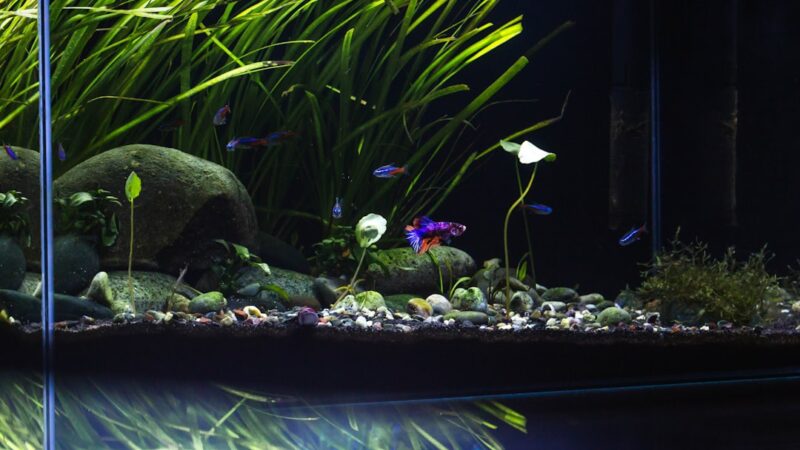
Divide your long tank into three vertical zones: left third, centre third, and right third. Your primary focal point should sit in either the left or right third, with secondary interest in the opposite third and transitional space in the centre. This asymmetric approach prevents the static, centred look that plagues many long-tank designs.
Use Repeating Elements to Unify
Repetition creates rhythm. A stone type that appears on both sides of the tank, or a plant species used in multiple sections, ties the composition together. The repetition does not need to be symmetrical — in fact, it should not be — but the echoing of elements across the width builds cohesion.
Create a Visual Journey
The eye should flow naturally from one end of the tank to the other, guided by the arrangement of hardscape, plants, and open space. Think of it as a landscape seen from a train window: there is a beginning, a middle, and an end, and the viewer’s gaze is led through the scene rather than jumping between isolated features.
Embrace Negative Space
In a long tank, open areas of substrate, sand paths, or unplanted zones are not wasted space — they are breathing room. Without negative space, the tank feels crowded and the eye has nowhere to rest. A well-placed open area also enhances the perceived size of the surrounding planted sections.
Layout Styles That Suit Long Tanks
| Layout Style | Description | Best Tank Length | Difficulty |
|---|---|---|---|
| Concave (U-shape) | Tall elements at both ends, open valley in the centre | 90–150 cm | Intermediate |
| Convex (Island) | Central mound tapering to low sides | 60–120 cm | Beginner |
| Triangular | Tall at one end, sloping to low at the other | 90–150 cm | Beginner |
| Multi-focal | Two or three distinct focal groups connected by transitional elements | 120–180 cm | Advanced |
| Panoramic Nature | A continuous landscape with gradual elevation changes, imitating a hillside or riverbank | 120–180 cm | Advanced |
For beginners working with a long tank, the concave layout is the most forgiving. The open centre provides natural negative space, while the planted ends frame the composition and give the eye clear anchor points.
Hardscape Placement Techniques
Group, Do Not Scatter
In a long tank, scattered individual stones or small pieces of driftwood look disorganised. Instead, group your hardscape into clusters — a primary group and one or two secondary groups. Each cluster should have a dominant piece supported by smaller complementary pieces.
Scale Up
Hardscape pieces that look large on a shop shelf can appear tiny in a 120 cm tank. Choose fewer, larger pieces rather than many small ones. A single imposing stone paired with two or three supporting stones creates more impact than a dozen pebbles.
Angle for Depth
Position stones and driftwood at angles rather than parallel to the front glass. A stone angled 30–45 degrees from the viewer suggests a path leading deeper into the scene. Driftwood that extends from front to back (rather than side to side) draws the eye into the tank, enhancing the sense of depth.
Bridge the Zones
If you have two hardscape groups (say, one in the left third and one in the right third), create a visual connection between them. This could be a low piece of driftwood stretching across the centre, a line of small stones suggesting a path, or a continuous moss carpet linking the two zones.
Step-by-Step: Planning Your Long Tank Layout
Step 1: Measure and Sketch
Measure your tank’s interior dimensions precisely. On paper, draw a rectangle to scale and divide it into thirds both horizontally and vertically. Mark where your focal points will sit — at the intersections of those thirds.
Step 2: Establish Substrate Elevation
Long tanks benefit enormously from sloped substrate. Build the substrate higher at the back (8–12 cm) and lower at the front (3–4 cm). If your layout is triangular, the substrate should also slope laterally — higher at the tall end, lower at the short end. Use substrate support materials (lava rock chunks, ADA Power Sand) beneath the soil to maintain steep slopes.
Step 3: Position Primary Hardscape
Place your largest, most striking hardscape piece at your primary focal point. Adjust its angle and orientation until it looks natural. View it from the front, from each end, and from above before moving on.
Step 4: Add Secondary Hardscape
Position supporting stones or driftwood around and across the tank. Ensure they relate to the primary piece in terms of material, colour, and style. Check from the viewing angle frequently.
Step 5: Dry-Run Your Plant Plan
Before adding water, place plant pots or markers where each species will go. This lets you visualise the final composition. Take a photograph at eye level to evaluate — cameras reveal imbalances that your eyes might overlook.
Step 6: Fill and Plant
Add water slowly to avoid disturbing the substrate, then plant from foreground to background. In a long tank, work one zone at a time to maintain consistency and avoid accidentally doubling up on species in one area.
Plant Zoning and Selection
In a long tank, zoning — assigning specific plant types to specific areas — is critical for maintaining order across the width.
Foreground Zone (Front 5–10 cm)
- Eleocharis parvula (Dwarf Hairgrass) — creates a meadow effect across the full width.
- Micranthemum ‘Monte Carlo’ — a low, creeping carpet that fills in quickly.
- Marsilea hirsuta — clover-like leaves, tolerates lower light at tank ends.
Midground Zone (Middle 10–20 cm)
- Cryptocoryne wendtii varieties — hardy, varied in colour, and well-suited to the moderate light of the midground.
- Staurogyne repens — compact and bushy, excellent for transitioning between foreground and background.
- Bucephalandra — attached to hardscape, it provides texture and variety without competing for substrate space.
Background Zone (Rear 10–15 cm)
- Rotala rotundifolia — fast-growing, fills vertical space, and can be trimmed to shape.
- Limnophila sessiliflora — feathery texture, grows densely, excellent for creating green walls behind hardscape.
- Vallisneria nana — tall, grass-like leaves that sway in the current, adding movement.
Accent Positions
Place one or two red or warm-toned plants at your focal points. In a long tank, a single cluster of Ludwigia Super Red or Rotala ‘H’ra’ positioned at the primary focal point draws the eye powerfully across the width.
Creating the Illusion of Depth
Long tanks are often shallow front-to-back, so depth illusion is paramount. Here are proven techniques.
Forced Perspective
Use smaller-leaved plants towards the back and larger-leaved plants in the front. This tricks the eye into perceiving greater distance. Similarly, place smaller stones at the back and larger ones at the front.
Substrate Slope
A steep back-to-front slope creates physical depth and makes background plants appear to tower over the foreground, increasing the sense of scale.
Paths and Channels
A sand path that narrows as it recedes from front to back is one of the most effective depth-creating tools in aquascaping. In a long tank, a winding path that enters from the front corner and disappears behind a midground hardscape group is spectacularly effective.
Colour Gradation
Lighter, warmer colours come forward visually; darker, cooler colours recede. Place bright green or red plants in the foreground and gradually transition to darker greens towards the back. This aerial perspective technique is borrowed directly from landscape painting.
Lighting Considerations for Long Tanks
Uniform lighting is one of the biggest practical challenges for long tanks.
| Tank Length | Recommended Lighting Approach | Notes |
|---|---|---|
| Up to 90 cm | Single long LED bar (80–90 cm) | Ensure the fixture spans the full tank length |
| 90–120 cm | Two LED fixtures placed end to end, or one extended fixture | Overlap slightly in the centre to avoid a dark band |
| 120–150 cm | Two or three fixtures, or a purpose-built long fixture | Consider pendant-style lights for even spread |
| 150 cm+ | Multiple fixtures with staggered timing (optional) | Sunrise-to-sunset effects across the length can be striking |
In Singapore, brands like Chihiros (WRGB II series), Twinstar, and ONF offer fixtures in lengths suited to long tanks. When shopping, check the fixture’s PAR distribution at the edges — many lights are brightest in the centre and significantly weaker at the ends.
Common Mistakes to Avoid
Centering Everything
A symmetrical layout in a long tank almost always looks static and artificial. Off-centre focal points, asymmetric plant groupings, and irregular hardscape placement feel far more natural and engaging.
Treating It as Multiple Small Tanks
A common beginner error is to create two or three separate “scenes” that do not relate to each other. The tank should read as one composition. Use connecting elements — continuous substrate, bridging hardscape, or shared plant species — to unify the design.
Insufficient Substrate Slope
Flat substrate in a long tank looks like a tabletop. Slope is your primary tool for creating visual interest and depth. Be bold with your elevation — a 10 cm rise from front to back is not too much for a 120 cm tank.
Uniform Plant Height
If your background plants are all the same height across the full width, the skyline looks flat and boring. Vary heights by trimming at different levels, using species of different mature heights, or allowing plants at the focal point to grow taller.
Ignoring the End Views
Long tanks are sometimes visible from the short sides (especially peninsula-style placements in living rooms). Check that your layout also looks presentable from the ends, not just the front.
Frequently Asked Questions
What is the ideal tank depth (front to back) for a long tank aquascape?
A depth of 36–45 cm gives you enough room for foreground, midground, and background zones while maintaining good light penetration. Tanks shallower than 30 cm are workable but limit your depth-of-field techniques. Tanks deeper than 50 cm are excellent but may require more powerful lighting to reach the substrate at the back.
Can I do an Iwagumi layout in a long tank?
Yes, and in fact Iwagumi is well-suited to long tanks because the style relies on open space, which a wide format provides abundantly. Use a strong Oyaishi (main stone) at one of the focal thirds, with supporting stones arranged according to traditional groupings. The extended width allows for generous open sand or carpet areas that define the Iwagumi aesthetic.
How do I handle water flow in a 120 cm or longer tank?
A single filter outlet rarely provides even circulation across the full length. Consider using a spray bar that spans most of the tank width, or add a small circulation pump (like a powerhead) at the opposite end from your main filter outlet. In Singapore’s warm climate, good circulation also helps distribute cooled water evenly if you are using a chiller or fan.
Do I need more CO2 for a long tank?
You need enough CO2 to achieve adequate dissolved concentration across the entire water volume. A long tank may benefit from a CO2 diffuser placed at the opposite end from the filter inlet, or an inline diffuser that distributes CO2 evenly via the filter flow. Monitor CO2 with a drop checker placed at the far end of the tank from the diffuser — if it reads green there, you have good distribution.
Related Reading
- How to Aquascape a Long Shallow Tank: Panoramic Layouts
- How to Create an African River Biotope Aquascape
- Amazon Biotope Aquarium: Blackwater, Tetras and Driftwood
- Amazon Clearwater Biotope Aquascape: Crystal Rivers of Brazil
- Amazon Igarapé Biotope Aquascape: Tiny Forest Creek
Conclusion
Knowing how to aquascape a long tank unlocks some of the most visually impressive compositions in the hobby. The wide format offers a panoramic canvas for storytelling, depth illusion, and dramatic hardscape arrangements that simply are not possible in standard-dimension tanks. With thoughtful planning, deliberate zoning, and attention to lighting and flow, your long tank can become the centrepiece of any room.
At Gensou, we specialise in aquascapes of all dimensions, including custom long-format tanks for homes, offices, and restaurants across Singapore. Our team at 5 Everton Park is ready to help you design, build, and maintain a long tank aquascape that exceeds your expectations.
Ready to make the most of your long tank?
- Get in touch to discuss your long tank project.
- Shop our range of hardscape, plants, and lighting suited to wide tanks.
- Explore our custom aquarium service for a bespoke long-format build.