




Description
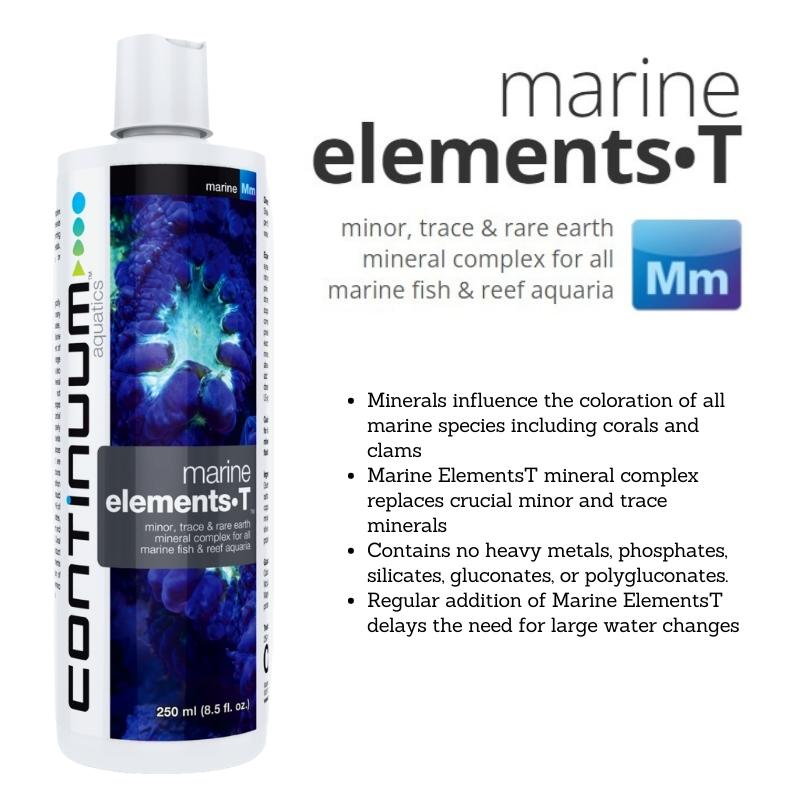
Minerals influence the coloration of all marine species including corals and clams
Marine ElementsT mineral complex replaces crucial minor and trace minerals
Contains no heavy metals, phosphates, silicates, gluconates, or polygluconates.
Regular addition of Marine ElementsT delays the need for large water changes
Marine ElementsT mineral complex replaces crucial minor and trace minerals lost to carbon filtration, protein skimming and ozone. It contains no heavy metals, phosphates, silicates, gluconates, or polygluconates.
Use in aquarium keeping.
Minor and trace minerals are biologically important to the health and vigor of many marine species including fish, invertebrates, and algae. Regular addition of Marine ElementsT provides for replenishment of these elements and delays the need for large water changes (we do not recommend that you avoid water changes and encourage a regimen of regular partial water changes, even though properly supplementing the system).
Minerals influence the coloration of all marine species including corals and clams and are important in many of the chemical reactions that take place in living tissues. In addition to Marine ElementsT, the hobbyist should pay close attention to the alkalinity, or KH of the system and, if keeping invertebrates, closely monitor the calcium, magnesium and strontium levels. For corals, Coral ElementsN will complement this product and will add vitamins and micro-nutrients necessary for corals and the addition of Coral Exponential will provide needed amino acids for coral tissue growth.
Directions and protocol.
Shake well prior to use.
Add 1 capful (5 ml) per 50 US-gallons (200 L) of marine aquarium water 1 to 2 times per week.
Expert use.
Dosing through use of a drip system is a superior method of addition. Do not mix with buffers or alkalinity supplements prior to addition. You may mix it with strontium, magnesium, and many other supplements. See our website for compatibility of supplements. It is not possible, with current test kits, to measure the exact dosage of Marine ElementsT trace minerals to add, so to dose, simply add the above amount to the doser. In other words, add 1 capful to the amount of solution that the doser will add in 2 to 4 days per 50 US-gallons (200 L) of marine aquarium water.
Caution: Keep out of reach of children. Not for human consumption. Contains trace minerals, if ingested drink water. If in eyes flush with water.
Continuum Marine Elements T for Trace Mineral Replacement
Marine Elements T replaces the minor and trace minerals that quietly disappear from a reef over time, pulled out by carbon filtration, protein skimming and ozone. Those trace elements influence the coloration of corals, clams and other marine life, so topping them up is part of keeping a display vivid rather than washed out. The formula deliberately leaves out heavy metals, phosphates, silicates, gluconates and polygluconates, so you are adding what the system needs without feeding algae or introducing pollutants.
Regular dosing also reduces how often you need to lean on large water changes purely to restore trace elements, which is welcome in Singapore where good RO water and salt mix add up over a year. That said, on most home reefs trace dosing complements a sensible water-change routine rather than replacing it entirely. Dose consistently and modestly, and let your corals’ colour response guide whether you are on the right track.
Explore our full marine additives range to build a balanced dosing plan. Our trace element dosing guide and SPS coloration chemistry guide go deeper on how trace minerals affect colour.





Reviews
There are no reviews yet.