
Neon Tetra Care Guide: The Classic Aquarium Fish
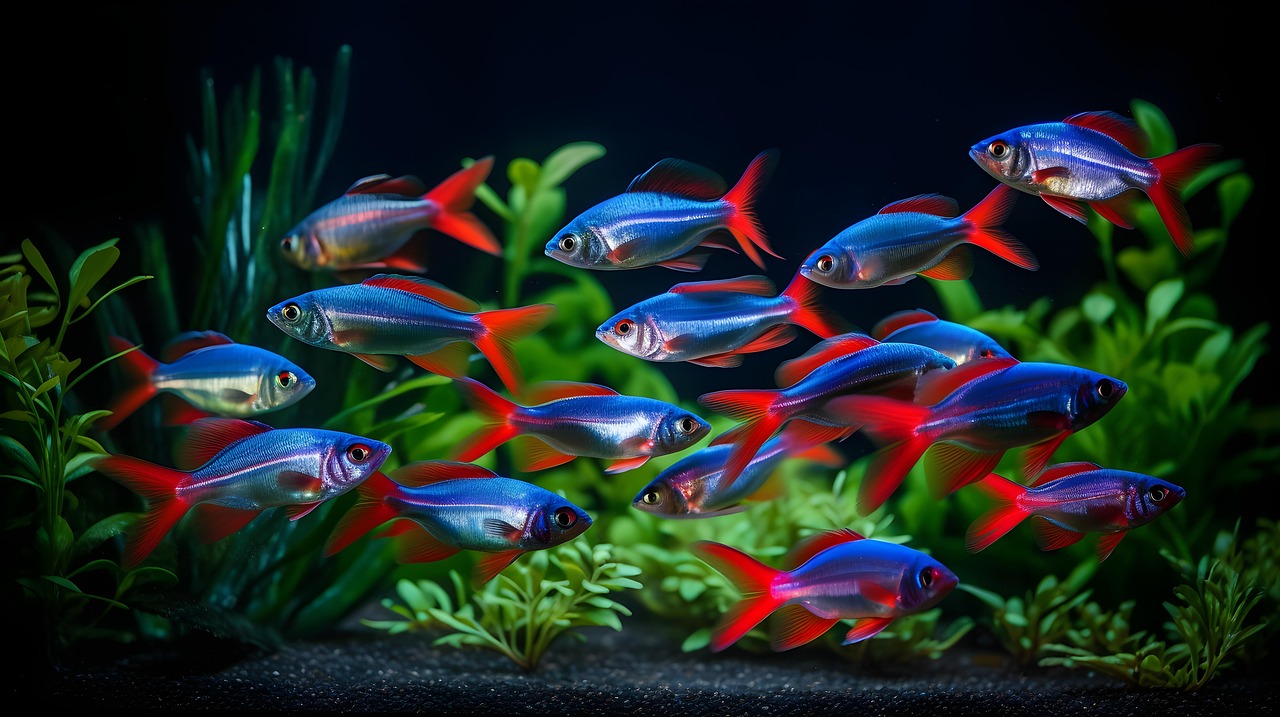
Few freshwater fish have captured the hearts of aquarists quite like the neon tetra (Paracheirodon innesi). With its iridescent blue stripe and vivid red tail, this tiny South American charmer has been a staple of community aquariums since the 1930s. But keeping neon tetras healthy in Singapore requires some specific considerations — particularly when it comes to temperature. This guide covers everything you need to know about neon tetra care, from tank setup to breeding. This guide sits inside our broader Freshwater Aquarium Complete Beginner Hub reference.
Origin and Appearance
Neon tetras originate from the blackwater streams of the upper Amazon basin, primarily in Peru, Colombia and Brazil. In the wild, they inhabit slow-moving tributaries shaded by dense rainforest canopy, where the water is soft, acidic and stained dark by tannins from decomposing leaves.
The fish’s most striking feature is its brilliant colouration. A bright, metallic blue-green stripe runs horizontally from the nose to the adipose fin, while a vivid red stripe extends from the mid-body to the tail. The belly is silvery-white. This combination creates a spectacular display when a school of neon tetras moves through a planted aquarium. Adults typically reach 3 to 4 centimetres in length and can live for five to eight years with proper care.
It is worth noting that neon tetras look quite similar to cardinal tetras, but the red stripe on a neon only extends halfway along the body, whereas a cardinal’s red runs the full length.
Water Parameters
Getting the water chemistry right is essential for neon tetra care. These fish evolved in very specific conditions, and while captive-bred specimens are somewhat more adaptable than wild-caught ones, they still have clear preferences.
| Parameter | Ideal Range | Notes |
|---|---|---|
| Temperature | 22 – 26 °C | Cooler than typical Singapore ambient |
| pH | 5.5 – 7.0 | Slightly acidic preferred |
| GH (General Hardness) | 2 – 10 dGH | Soft water ideal |
| KH (Carbonate Hardness) | 1 – 5 dKH | Low buffering capacity |
| Ammonia / Nitrite | 0 ppm | Sensitive to any detectable levels |
| Nitrate | Below 20 ppm | Weekly water changes recommended |
Singapore’s PUB tap water generally sits around pH 7.0 to 8.5 with moderate hardness. For neon tetras, you may want to use a mix of tap water and reverse osmosis (RO) water to soften it, or add Indian almond leaves and driftwood to naturally lower pH and introduce beneficial tannins.
Tank Size and Setup
A minimum tank size of 40 litres (roughly 10 US gallons) is recommended for a school of neon tetras, though a 60-litre tank or larger gives them more swimming room and provides a more stable environment. Neon tetras are active mid-water swimmers that appreciate horizontal swimming space over height.
Ideal Tank Setup
- Substrate: Fine gravel or aquasoil — dark substrates bring out the best colouration
- Plants: Dense planting with Java fern, Cryptocoryne, Anubias and stem plants provides cover and mimics their natural habitat
- Lighting: Moderate — neon tetras come from shaded environments and look their best under subdued lighting
- Filtration: A gentle sponge filter or hang-on-back filter with reduced flow works well, as neons prefer calm water
- Decor: Driftwood and dried leaves create a natural blackwater biotope
If you are setting up a custom aquarium for neon tetras, consider a blackwater-themed planted tank. The tannin-stained water not only suits their biology but also makes their colours pop brilliantly against the amber tones.
Feeding
Neon tetras are omnivores with small mouths, so food particle size matters. In the wild, they feed on tiny invertebrates, algae and fallen fruit. In captivity, a varied diet keeps them healthy and colourful.
Recommended Diet
- Staple: High-quality micro pellets or crushed tropical flakes
- Supplementary: Frozen or live baby brine shrimp, daphnia, micro worms
- Occasional treats: Freeze-dried bloodworms (sparingly — can cause bloating)
Feed small amounts twice daily — only as much as the school can consume within two minutes. Overfeeding is one of the most common mistakes in neon tetra care and quickly degrades water quality.
Schooling Behaviour
Neon tetras are obligate schooling fish. Keeping them in groups of fewer than six causes visible stress — they become skittish, lose colour and hide constantly. A minimum group of eight to ten is recommended, and larger schools of 15 to 20 create a truly spectacular display.
In a well-planted tank with a proper school, neon tetras exhibit fascinating coordinated movement. They swim in loose formations during the day, tightening up when they sense potential threats. This behaviour is one of the main reasons they remain so popular — a large school moving through a planted aquascape is mesmerising.
Tank Mates
Neon tetras are peaceful community fish, but their small size makes them vulnerable to larger or aggressive species. Choosing compatible tank mates is crucial.
Good Tank Mates
- Corydoras catfish — peaceful bottom-dwellers that complement neons perfectly
- Otocinclus catfish — gentle algae eaters
- Harlequin rasboras — similar size and temperament
- Ember tetras — another small, peaceful tetra
- Cherry shrimp — though very small shrimp fry may be eaten
- Dwarf gouramis — generally peaceful top-dwellers
Tank Mates to Avoid
- Angelfish — will eat neon tetras once large enough
- Bettas — can be aggressive, though individual temperaments vary
- Cichlids (most species) — too aggressive or predatory
- Large barbs — can nip fins and stress neons
Breeding
Breeding neon tetras is notoriously challenging but not impossible. They are egg scatterers that require very specific conditions to spawn.
Breeding Conditions
- Set up a separate breeding tank of 10 to 20 litres with a sponge filter
- Use very soft water (1-2 dGH) with a pH of 5.0 to 6.0
- Keep the temperature at 24 °C
- Provide spawning mops or fine-leaved plants like Java moss
- Keep the tank very dim — neon tetra eggs are light-sensitive
- Condition a pair with live foods for one to two weeks before introducing them to the breeding tank
Spawning typically occurs in early morning. The female scatters 60 to 120 eggs, which fall through the spawning mop. Remove the adults immediately after spawning, as they will eat the eggs. Eggs hatch in approximately 24 hours, and the fry become free-swimming after three to four days.
Common Diseases
Neon tetras are susceptible to several diseases, the most infamous being neon tetra disease (NTD), caused by the parasite Pleistophora hyphessobryconis.
Neon Tetra Disease
Symptoms include fading colour, restlessness, difficulty swimming, a lumpy body shape and eventual isolation from the school. Unfortunately, there is no cure. Affected fish should be removed immediately to prevent spread. The best prevention is quarantining new fish for two to three weeks before adding them to your main tank.
Other Common Issues
- Ich (White Spot Disease): White spots on the body and fins. Treatable with temperature increase and medication, though neons are sensitive to some treatments — use half doses
- Fin rot: Often caused by poor water quality. Improve conditions and treat with antibacterial medication if needed
- Columnaris: White or greyish patches. Requires prompt antibiotic treatment
Singapore-Specific Considerations
Here is the critical issue for keeping neon tetras in Singapore: temperature. With ambient room temperatures regularly reaching 28 to 32 °C, especially during the hotter months of April to June, your tank water will easily exceed the neon tetra’s preferred range of 22 to 26 °C.
The Chiller Question
For long-term neon tetra care in Singapore, an aquarium chiller is strongly recommended. Sustained temperatures above 28 °C stress neon tetras, weaken their immune systems and shorten their lifespan significantly. You have several options:
- Aquarium chiller: The most reliable solution. A quality chiller can maintain temperatures at 24 to 26 °C year-round
- Air-conditioned room: If your tank is in an air-conditioned bedroom or study that stays at 24 to 25 °C, this may suffice
- Cooling fans: Can drop temperatures by 2 to 4 °C through evaporation, but may not be enough during Singapore’s hottest periods
If investing in a chiller is not feasible, consider species better suited to Singapore’s warmth, such as ember tetras or Endler guppies, which tolerate higher temperatures comfortably.
Water Preparation
Singapore’s PUB tap water is treated with chloramine, which must be neutralised with a quality water conditioner before use. The water tends to be slightly alkaline and moderately hard — suitable for neon tetras after some adjustment. Adding botanicals like catappa leaves or peat filtration can help achieve the softer, more acidic conditions neons prefer.
For aquarists looking to create the ideal setup for neon tetras or any other tropical species, Gensou offers professional aquarium maintenance services to help you maintain pristine water conditions year-round.
Frequently Asked Questions
How many neon tetras should I keep together?
A minimum of eight to ten neon tetras is recommended, though a school of 15 or more is ideal. Keeping fewer than six causes significant stress and leads to washed-out colours, skittish behaviour and a weakened immune response. The more neons you keep, the more confident and colourful they become.
Can neon tetras survive without a chiller in Singapore?
It depends on your setup. If your tank is in an air-conditioned room that stays consistently below 27 °C, neon tetras can do well. However, in a non-air-conditioned HDB flat where temperatures regularly hit 30 °C or higher, a chiller is necessary for their long-term health. Without one, you will likely see increased disease susceptibility and shortened lifespans.
Why are my neon tetras losing colour?
Colour loss in neon tetras can indicate stress from poor water quality, incorrect temperature, illness (particularly neon tetra disease), insufficient group size, or aggressive tank mates. Test your water parameters, check the temperature, and ensure the school is large enough. Some colour fading at night is normal — neons naturally pale when resting in darkness.
What is the difference between neon tetras and cardinal tetras?
The easiest way to tell them apart is the red stripe. On neon tetras, the red extends only from the mid-body to the tail. On cardinal tetras, the red stripe runs the full length of the body, from head to tail. Cardinals also tend to be slightly larger and are generally considered more intensely coloured. Both species have similar care requirements, though cardinals tolerate slightly warmer water, making them a marginally better choice for Singapore aquarists.
Whether you are setting up your first neon tetra tank or looking to upgrade an existing community aquarium, Gensou can help. From custom aquarium design to ongoing maintenance, our team understands the unique challenges of tropical fishkeeping in Singapore. Get in touch to discuss your project.
Related Reading



