
Veil Angelfish Care Guide: Trailing Fin Variety
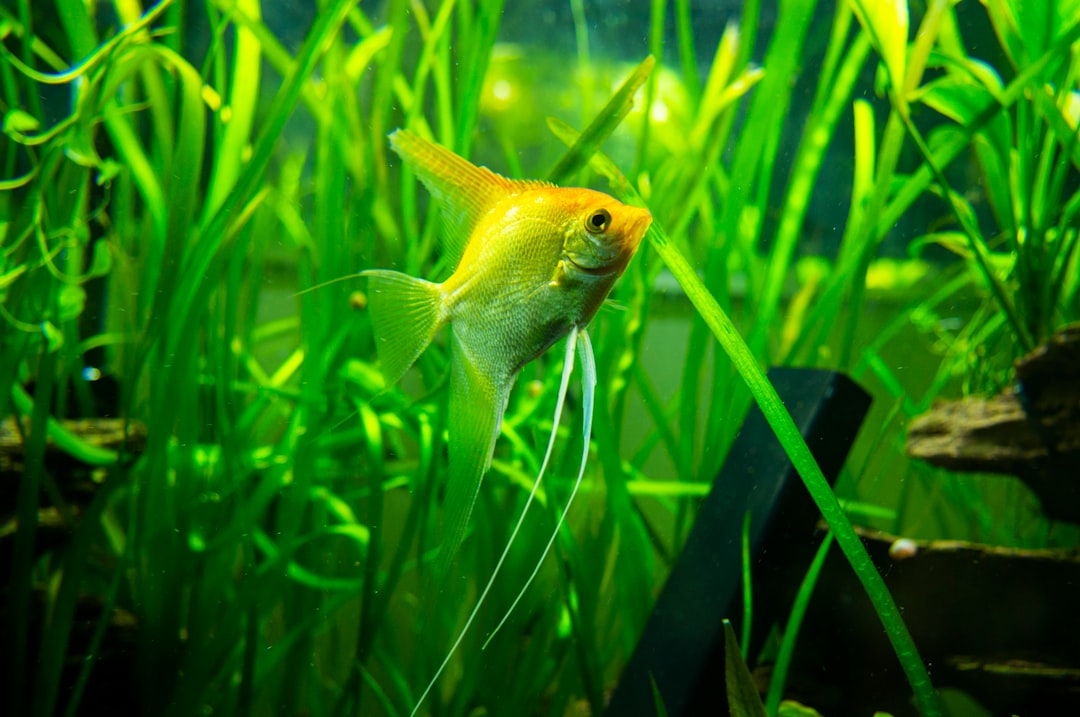
A veil angelfish is the classic flowing-fin strain that has been in the hobby since the late 1950s. Trailing dorsal, anal, and caudal extensions give the fish a sweeping silhouette as it glides through the tank. This veil angelfish care guide from Gensou Aquascaping in Everton Park, Singapore explains the single-copy veil genetics, how to keep fins intact in a tropical tank, and the practical differences between veil and super-veil expressions. The fish is still Pterophyllum scalare — a selectively bred form of the Amazonian silver angel, not a separate species.
Quick Facts
- Scientific name: Pterophyllum scalare (veil fin form)
- Genetics: incomplete-dominant veil (V) allele — one copy = veil, two copies = super veil
- Adult size: 13-15 cm body, 22-28 cm fin-to-fin with trailing extensions
- Minimum tank: 220 litres, 50 cm tall
- Water: pH 6.5-7.5, GH 3-10, 26-29 degC
- Flow: gentle — direct currents damage trailing filaments
- Lifespan: 7-9 years
Veil Genetics — Single vs Double Dose
The veil allele (V) is incomplete dominant. A fish carrying one copy (V/+) shows the classic single-veil look — extended but still manageable fins. Two copies (V/V) produce super veil, with filaments that can reach 1.5 times body length. Super veils are stunning but fragile; single veils are the pragmatic choice for a display aquarium. Breed single x single and expect 25 percent standard-fin, 50 percent veil, 25 percent super veil.
Tank Size and Aquascape
A 100 x 45 x 50 cm tank (around 220 litres) handles a pair. Choose taller footprints over shallower ones — trailing fins need vertical clearance. Aquascape with Amazon sword, Vallisneria, and smooth driftwood. Avoid needle-sharp hardscape such as Seiryu edges that can tear fins on contact. A sand or fine gravel substrate is safer than coarse gravel.
Flow Management
Veils suffer in tanks built around strong flow. Use a canister filter with spraybar pointed at the back pane to create a gentle circular return. A 4-5x turnover rate is enough; reef-style wavemakers or high-flow circulation pumps will steadily erode the fin edges. Surface agitation remains important for oxygen exchange — just keep the strong flow off the fish.
Water Parameters
Veils are as hardy as standard scalare. Singapore PUB tap water, after dechlorination, lands in the usable pH 7.4-7.8 range — slightly alkaline but workable. Blend with RO if you want to push pH under 7.0 for spawning. Temperature at 26-28 degC, GH 3-8, nitrate under 20 ppm. Weekly 25 percent water changes maintain fin health.
Diet
Omnivorous with no special requirements. A staple pellet — NLS Thera-A or Hikari Vibra Bites — covers the base. Rotate frozen bloodworms, frozen brine shrimp, and live daphnia twice a week. Vitamin-enriched foods once a week help fin regeneration if damage occurs. Feed twice daily, small portions, fasted one day per week.
Compatible Tank Mates
The fin-nipping risk dominates stocking choices. Safe companions include rummynose tetras, lemon tetras, cardinal tetras (large enough not to be eaten), harlequin rasboras, Corydoras, bristlenose plecos, and keyhole cichlids. Avoid barbs and serpae tetras entirely. Two veils of matched size coexist well; a group of six in a larger tank allows natural pairing.
Common Issues and Longevity
Fin rot is the recurring concern in warm, humid Singapore conditions. Stable water, moderate flow, and absence of nippers prevent most cases. If edges turn ragged, a 30 percent water change plus API Furan-2 or similar resolves it within a week. Breeders in Johor supply consistent veil stock to Singapore shops; expect $10-20 SGD for juveniles and $30-50 SGD for adult pairs.
Related Reading



