
Caridina Shrimp Care Guide: Crystal Red, Bee and Taiwan Bee
Caridina Shrimp Care Guide: Crystal Red, Bee and Taiwan Bee
If Neocaridina cherry shrimp are the reliable family car of the shrimp hobby, Caridina shrimp are the high-performance sports car: more demanding, more expensive, and far more thrilling when everything is dialled in. This Caridina shrimp care guide covers the essential differences from Neocaridina, popular types, water requirements, and the grading systems that determine value.
Table of Contents
- Caridina vs Neocaridina: Key Differences
- Popular Caridina Types
- Water Parameters
- RO Water: Why It Is Essential
- Active Substrate and Buffering
- Temperature: The Singapore Challenge
- Tank Setup
- Feeding
- Grading System
- Breeding
- Frequently Asked Questions
Caridina vs Neocaridina: Key Differences
The care requirements differ significantly between these genera.
| Factor | Neocaridina (e.g. Cherry Shrimp) | Caridina (e.g. Crystal Red) |
|---|---|---|
| Water hardness | Moderate (4-8 dGH) | Very soft (3-6 dGH) |
| pH | 6.5-8.0 | 5.5-6.8 |
| TDS | 150-300 ppm | 100-180 ppm |
| Temperature | 22-28 °C | 20-24 °C |
| Water source | Treated tap water | RO + remineraliser |
| Substrate | Any (inert fine) | Active/buffering substrate |
| Tolerance for error | Forgiving | Unforgiving |
| Price range (SGD) | $1-20 | $5-500+ |
Caridina shrimp require more precise conditions and equipment, but they are not difficult once you understand the parameters.
Popular Caridina Types
Crystal Red Shrimp (CRS)
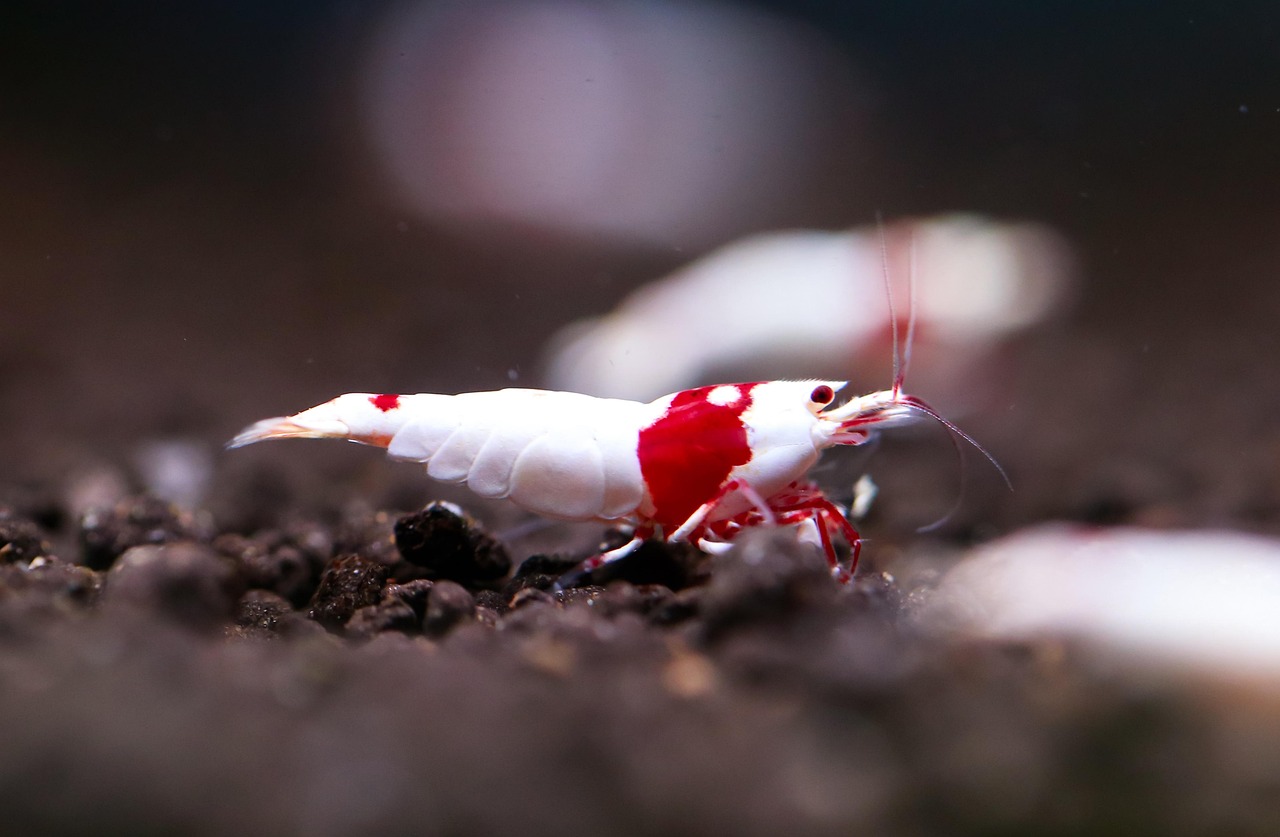
The gateway Caridina for many hobbyists. CRS display alternating bands of white and red, originally selectively bred from bee shrimp in Japan. Higher grades show more opaque white and deeper red with sharper definition.
Crystal Black Shrimp (CBS)
The black and white counterpart to CRS, with identical care. High-grade CBS with jet-black bands and snow-white contrast are extremely attractive.
Tiger Shrimp
Vertical black stripes over a translucent or coloured body. Popular variants include orange-eyed blue tiger (OEBT), super tiger, and tangerine tiger. Some tiger varieties tolerate slightly harder water than bee shrimp.
Taiwan Bee Shrimp
The crown jewels of the Caridina world — mutations that produce dramatically different colour patterns:
- King Kong — Solid black body with no white bands.
- Panda — Black and white with larger blocks of colour than banded CRS/CBS.
- Pinto — Spotted or “painted” pattern, highly variable and often uniquely patterned.
- Red Ruby / Red Wine — Deep, solid red body.
- Shadow Bee — Various dark variants including shadow mosura and shadow panda.
Taiwan bee shrimp command the highest prices, with exceptional specimens selling for hundreds of dollars. They require the same conditions as CRS/CBS but are slightly more delicate.
Water Parameters
Precision is everything with Caridina shrimp. Target parameters for bee and Taiwan bee varieties:
| Parameter | Target Range | Notes |
|---|---|---|
| Temperature | 22-24 °C | Chiller essential in SG |
| pH | 5.8-6.5 | Buffered by active substrate |
| GH | 4-6 dGH | Set with remineraliser |
| KH | 0-1 dKH | Must be very low |
| TDS | 100-150 ppm | Monitor with TDS meter |
| Ammonia | 0 ppm | Any reading is dangerous |
| Nitrite | 0 ppm | Any reading is dangerous |
| Nitrate | Below 10 ppm | Lower is better |
A TDS meter, GH test kit, and reliable thermometer are essential monitoring tools.
RO Water: Why It Is Essential
Singapore’s PUB tap water has a TDS of roughly 80-120 ppm, a GH around 4-5, and a pH near 7.0. While those numbers seem close, the mineral composition is wrong for sensitive Caridina. The standard approach:
- Start with RO (reverse osmosis) water at 0 TDS.
- Add a Caridina-specific remineraliser (such as SaltyShrimp GH+) to reach target GH of 4-6 and TDS of 100-150 ppm.
- Do not add KH. Use a GH-only remineraliser; KH buffering comes from the active substrate.
For guidance on RO systems and water preparation, see our RO water aquarium guide.
Active Substrate and Buffering
Active substrates (buffering aquasoils) are a cornerstone of Caridina keeping. Brands like ADA Amazonia, Tropica Aquarium Soil, and SL-Aqua are popular in Singapore. Key points:
- They lower pH to approximately 5.5-6.5 and absorb KH from the water column.
- New substrate releases ammonia during cycling. Never add shrimp to a fresh tank — cycle 4-6 weeks minimum until ammonia and nitrite read 0 ppm.
- Buffering depletes after 12-24 months. When pH drifts upward, the substrate needs replacing.
- Do not use tap water for changes, as KH accelerates buffering depletion — another reason RO water is essential.
Temperature: The Singapore Challenge
The target temperature of 22-24 °C is dramatically below Singapore’s ambient 28-32 °C. Without active cooling, Caridina shrimp suffer heat stress, reduced breeding, and premature death. Options:
- Aquarium chiller — The most reliable solution, maintaining precise control regardless of ambient conditions. See our guide to aquarium chillers in Singapore.
- Aquarium fan — Lowers temperature by 2-4 °C. Useful supplementally but generally insufficient alone for Caridina.
- Air-conditioned room — Running aircon at 22-24 °C 24/7 works but is expensive. Popular among bedroom shrimp keepers.
A chiller is a significant upfront investment but prudent insurance for shrimp worth tens or hundreds of dollars each.
Tank Setup
Caridina tanks are typically functional rather than elaborately aquascaped:
- Tank size: 30-60 litres. Smaller tanks are harder to keep stable.
- Substrate: Active/buffering aquasoil, 3-5 cm deep.
- Filtration: Sponge filter (safe for shrimplets) or canister with sponge pre-filter.
- Hardscape: Driftwood for biofilm, lava rock, or dragon stone.
- Plants: Mosses provide grazing surfaces and shrimplet shelter. Bucephalandra and anubias also work well.
- Chiller: Connected inline or via sump.
- Indian almond leaves: For tannins and biofilm.
Feeding
Caridina shrimp are omnivorous scavengers. A varied diet supports health, colour, and breeding:
- Specialty shrimp foods — Glasgarten, SL-Aqua, and Borneo Wild produce Caridina-specific formulas. Rotate protein-based and plant-based options.
- Blanched vegetables — Spinach, nettle, moringa, and mulberry leaves.
- Biofilm — The most important food source, growing naturally on surfaces, driftwood, leaves, and moss.
- Mineral supplements — Cuttlebone provides calcium for moulting support.
Feed sparingly, two to three times per week. Overfeeding degrades water quality quickly. Remove uneaten food promptly.
Grading System
Caridina bee shrimp, particularly CRS and CBS, follow a grading system based on the ratio of white to red (or black) and the pattern of banding:
| Grade | White Coverage | Description | Approx. SGD Price |
|---|---|---|---|
| C | Minimal | Mostly red/black with thin white bands | $3-5 |
| B | Some | Clear banding but red/black dominant | $5-10 |
| A | Moderate | Balanced red/white or black/white bands | $8-15 |
| S | High | More white than colour, clean pattern | $15-30 |
| SS | Very high | Predominantly white with minimal colour bands (Hinomaru, no-entry pattern) | $30-80 |
| SSS | Extreme | Nearly all white with a single colour marking (Mosura, crown pattern) | $80-300+ |
Higher grades have more opaque white coverage, sharper pattern definition, and more desirable pattern types (Mosura, crown, flower). Taiwan bee shrimp are graded differently, primarily on colour intensity, opacity, and pattern uniqueness.
Breeding
Females carry 20-30 eggs for approximately 28-35 days before releasing fully formed miniature shrimp that begin grazing biofilm immediately. Key considerations:
- Stable parameters — Consistency matters more than exact numbers. Fluctuations trigger failed moults.
- Temperature — Most productive at 22-23 °C.
- Biofilm — Essential shrimplet food. Moss-rich tanks give the best survival rates.
- Avoid cross-breeding — Mixing CRS and CBS produces mixed offspring. Consult experienced breeders before mixing Taiwan bee lines.
Frequently Asked Questions
Can I keep Caridina shrimp without a chiller in Singapore?
In a 24/7 air-conditioned room set to 22-24 °C, yes. Without aircon or a chiller, no. Singapore’s ambient temperatures are too high for Caridina shrimp to thrive long-term. An aquarium fan alone typically cannot achieve the necessary temperature reduction. A chiller is the most reliable solution and a worthwhile investment given the cost of the shrimp themselves.
Can I keep Caridina and Neocaridina together?
They will not interbreed, but their water parameter requirements are quite different. Neocaridina prefer harder, more alkaline water at warmer temperatures. Keeping both in Caridina conditions (soft, acidic, cool) may work for the Neocaridina but is not ideal. Most serious shrimp keepers maintain separate tanks for each genus.
How long does it take for active substrate to stop buffering?
Typically 12-24 months, though this varies with water source, water change frequency, and substrate depth. Monitor pH regularly. When you notice pH creeping upward despite water changes with RO water, the substrate’s buffering capacity is depleting. At this point, the substrate needs replacing, which requires a full tank reset. Some keepers add a thin layer of fresh substrate on top to extend the life, but this is a temporary measure.
Why are my Caridina shrimp dying after water changes?
Usually a parameter mismatch. Always prepare replacement water to match the tank’s TDS and temperature. Change no more than 10-15% at a time and drip slowly. Sudden shifts in pH, TDS, or temperature trigger failed moults and death.
Take the Next Step
Caridina shrimp keeping is more demanding, but the combination of precision water management, selective breeding, and stunning specimens makes it one of the most absorbing niches in the hobby.
Visit Gensou Aquascaping at 5 Everton Park for quality stock, RO equipment, active substrates, and expert advice from over 20 years of experience. Contact us to discuss your setup before you buy.
Related Reading
- Amano Shrimp Breeding Challenges: Larval Stages and Saltwater Phase
- How to Breed Amano Shrimp: The Challenging but Rewarding Process
- Amano Shrimp vs Cherry Shrimp: Which Is Better for Your Tank?
- Amano Shrimp vs Otocinclus: Which Algae Crew Wins?
- Aura Blue Shrimp Care Guide: Caridina Cantonensis Blue Morph



