Negative Space Ratio Principles: Aquascape Composition
The emptiness in a great aquascape carries as much weight as the hardscape and planting. This guide to negative space ratio principles explains how to measure, calibrate and defend the open areas that most beginners instinctively fill with another plant or another stone. The ideas come from Japanese sumi-e ink painting and karesansui dry-garden design, refined over decades of competition prep at Gensou Aquascaping in 5 Everton Park and translated into practical rules for Singapore HDB-tank realities from 30 cm nanos to 120 cm galleries.
Defining Negative Space in a Tank
Negative space is any area of the composition not occupied by hardscape, planted mass or visually dominant features. In an aquascape it typically appears as open substrate, open water column above the carpet, and gaps between hardscape clusters. It is not dead space — it provides breathing room for the eye and allows the positive elements to read clearly. Remove the negative space and a composition collapses into visual noise within seconds.
The Target Ratio
A reliable starting ratio is 40 to 60 percent negative space by tank volume for nature-style scapes, and 30 to 50 percent for iwagumi. Dutch-style tanks sit lower at 15 to 25 percent because they are intentionally dense. Measure visually from the front viewing pane rather than mathematically — sketch an outline of where hardscape and plant silhouettes sit, and estimate the unfilled fraction. Our negative space guide includes reference diagrams.
Open Foreground as Visual Anchor
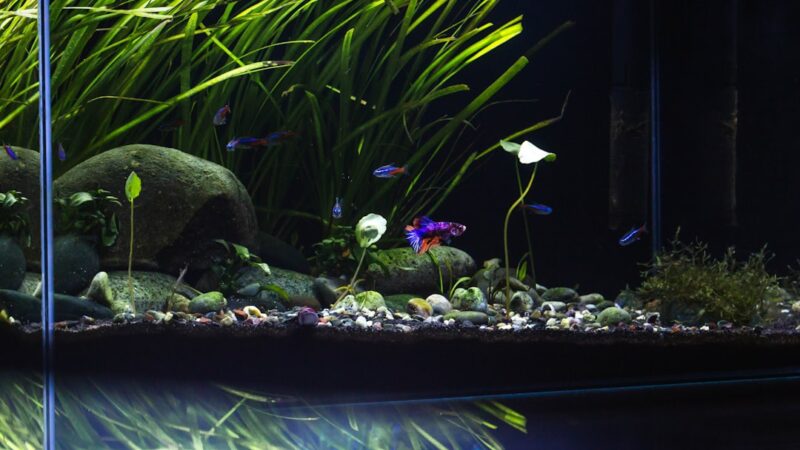
A swept open substrate foreground is the most powerful negative-space technique available. Leave 25 to 35 percent of the front third of your tank free of plants, using fine pale sand like ADA La Plata or Maruhachi silica. The eye lands there first, then travels upward and backward into the hardscape. Planting the foreground solid with Monte Carlo or dwarf baby tears feels lush but eliminates this visual landing zone.
Open Water Column Above Carpets
The vertical space between your substrate plants and the water surface is negative space, and it should be respected. Tall stems that reach surface level eliminate this zone and make the tank feel cramped. Aim to leave the top third of the water column largely open, with only occasional floating plants or a single cluster of pogostemon breaking the surface. Our plant grouping guide covers height tiers.
Gaps Between Hardscape Clusters
In layouts with multiple stone or wood clusters, the gap between clusters must be substantial — at least 30 to 40 percent of the smaller cluster’s width. Closing those gaps merges the clusters into a single visual mass and eliminates the implied depth. A path layout demonstrates this principle most clearly: the path itself is negative space, and narrowing it kills the depth illusion from our vanishing point path technique.
Why Beginners Fill Negative Space
Empty substrate feels wrong to new hobbyists because it reads as unfinished. The instinct is to add another anubias, another stone, another stem cluster. Resist it. Finished competition scapes contain far less hardscape and planting mass than hobbyists expect — IAPLC top-30 entries regularly sit at 50 percent plus negative space. Restraint is the most underrated aquascaping skill.
Scaling Negative Space to Tank Size
Small tanks need proportionally more negative space than large ones. A 30 cm cube at 40 percent filled already reads as cluttered because the absolute volume is tiny. Aim for 65 to 75 percent negative space in nanos to preserve visual calm. In 120 cm tanks, 40 percent works because the absolute scale of open sand or water reads as generous. Our nano 5 litre guide covers micro-scale density.
Singapore HDB Viewing Distance Considerations
Typical HDB living-room viewing distances sit at 1.5 to 2.5 metres from the tank. At those distances the eye reads overall composition more than fine detail, so negative space ratios matter more than individual plant choices. For tanks in tight bedroom or study setups with 60 to 80 cm viewing distance, reduce negative space to 35 to 45 percent — very close viewing rewards more detail density.
Maintaining Negative Space Over Time
Stems grow, carpets spread, moss creeps. A scape that hit 50 percent negative space on flooding day usually sits at 25 percent by month three without trimming. Schedule trim weeks for your fast-growing species, pull back encroaching carpets at the path or open foreground edge, and thin stem clusters by 40 percent every six to eight weeks. Our maintenance routine covers the rhythm.
Photographing Negative Space
Front-on photographs at eye level flatter negative space more than high-angle shots, which compress the open substrate into a narrow strip. For portfolio and competition entries, shoot from the sofa distance with the lens at exactly substrate level, then again at mid-tank height. Our aquascape photography tips cover the settings. Judges look for breathing room, and bad angles hide it.
Related Reading